ECAT: Test Structure, Subject Combinations and Which Programmes Require It
ECAT is the combined entrance test conducted by the University of Engineering and Technology (UET) Lahore. It has run since 1999 under directives from the Government of Punjab, and under Pakistan Engineering Council notifications it is mandatory for admission to undergraduate engineering programmes at both public and private engineering institutions.
That last point catches people out. Applicants often treat it as a public-sector requirement and assume a private engineering university offers a way around it. On PEC’s notifications, it does not.
What the paper looks like
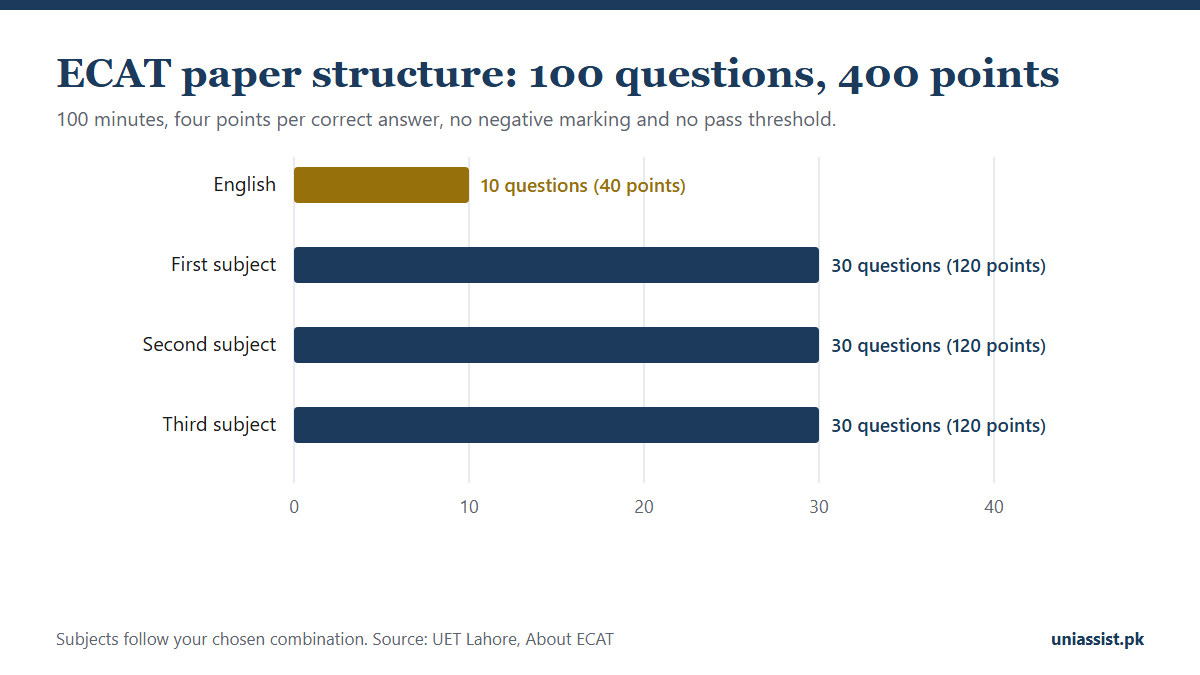
The test is set at Intermediate level and runs for 100 minutes. It contains 100 questions: 10 on English, and the remaining 90 divided equally among the three subjects in your chosen combination, 30 each.
Each correct answer is worth four points, which makes it a 400-point paper. Two features of the marking matter more than most candidates realise:
- There is no negative marking. Leaving a question blank gains you nothing that a guess would cost. On a paper with no penalty, unanswered questions are pure forfeited marks.
- There is no passing threshold for any programme. It is not an exam you pass or fail; it produces a score that feeds a merit position. A “good enough” score does not exist in the abstract; it exists only relative to the merit list for the programme you want.
UET also allows multiple attempts, in compliance with PEC instructions, and your best score is the one used for merit. A weak first attempt does not end the year.
The five subject combinations
You choose one combination, based on the subjects you took at Intermediate or equivalent:
| # | Combination |
|---|---|
| i | Mathematics, Physics and Chemistry |
| ii | Mathematics, Physics and Computer Science |
| iii | Mathematics, Statistics and Computer Science |
| iv | Biology, Physics and Chemistry |
| v | Mathematics, Statistics and Physics |
DAE-qualified candidates have a narrower choice. They may sit only Physics, Mathematics, English and Chemistry, or Physics, Mathematics, English and Computer Science.
Not every UET programme needs ECAT
UET Lahore and its campuses divide their offerings into ECAT and non-ECAT programmes, and the split does not follow the line most people assume. Computer Science, Software Engineering, Artificial Intelligence, Cyber Security and Data Science all sit on the ECAT side at UET Lahore, alongside the engineering disciplines.
On the non-ECAT side at Lahore are Business Administration, Chemistry, Physics, Mathematics, English Language and Literature, Environmental Science, Interior Design, Material Sciences, Logistics and Supply Chain Management, Industrial Chemistry, Remote Sensing and GIS, and others.
The same division runs across the campuses. UET Faisalabad lists Chemical, Computer, Electrical, Mechatronics and Textile Engineering plus Computer Science, Cyber Security and Data Science as ECAT programmes, with Chemistry, Industrial Chemistry, Mathematics and Textile and Fashion Design outside it. RCET Gujranwala, UET Narowal and the UET KSK New Campus each publish their own lists.
Check which side your programme falls on before you buy a test token. Registering for the test for a programme that does not require it is a wasted fee; missing it for one that does is a lost year.
On the day
Photo identification is required at the test centre, and failure to present it may result in expulsion. UET accepts a CNIC or NICOP, a NADRA juvenile card, a Matric or Intermediate certificate carrying a photograph, a computerised domicile certificate bearing a photograph, a passport, or, for A Level candidates, a Statement of Entry.
Three administrative rules are worth reading before you plan around them:
- A candidate who misses the test in the allotted centre during the allotted time slot will not be permitted to retake it.
- The test is fully automated, so no re-checking facility is provided.
- An entrance test token, once purchased, is non-refundable and non-transferable, whether or not it is used.
UET is also explicit that anyone may sit the test, but that appearing in it does not by itself confer the right to apply for admission to engineering institutions in Punjab. Eligibility for a programme is a separate question from eligibility to sit the test.
Common questions
How many marks is ECAT out of?
There are 100 questions worth four points each, so the paper carries 400 points. Ten of those questions are English and the other 90 are split evenly across your three chosen subjects.
Is there negative marking in ECAT?
No. UET states there is no negative marking and no passing threshold for any programme.
Can I sit ECAT more than once?
Yes. In compliance with PEC instructions, applicants are allowed multiple attempts and the best score is used to determine merit.
Do private engineering universities require ECAT?
Under the PEC notifications UET cites, the entrance test is mandatory for admission to undergraduate engineering programmes at both public and private engineering institutions.
Can a Pre-Medical student sit ECAT?
Combination (iv) is Biology, Physics and Chemistry, so a Pre-Medical subject background has a route into the test. Whether a given engineering programme then admits on that combination is set by the institution.
Sources
- UET Lahore, About ECAT: ecat.uet.edu.pk
- UET Lahore, Programs (ECAT and non-ECAT programmes by campus): ecat.uet.edu.pk
For how ECAT compares with the other engineering routes, see our guide to engineering admission tests in Pakistan.