University Entry Tests in Pakistan: Which One You Need
Pakistan has no single university entrance exam. Which of the entry tests in Pakistan you sit depends on the field you are entering, the province you are applying in, and sometimes the individual institution. Applicants lose places every year by preparing for the wrong one, or by discovering a required test after its registration window has closed. This guide sets out which test governs which route.
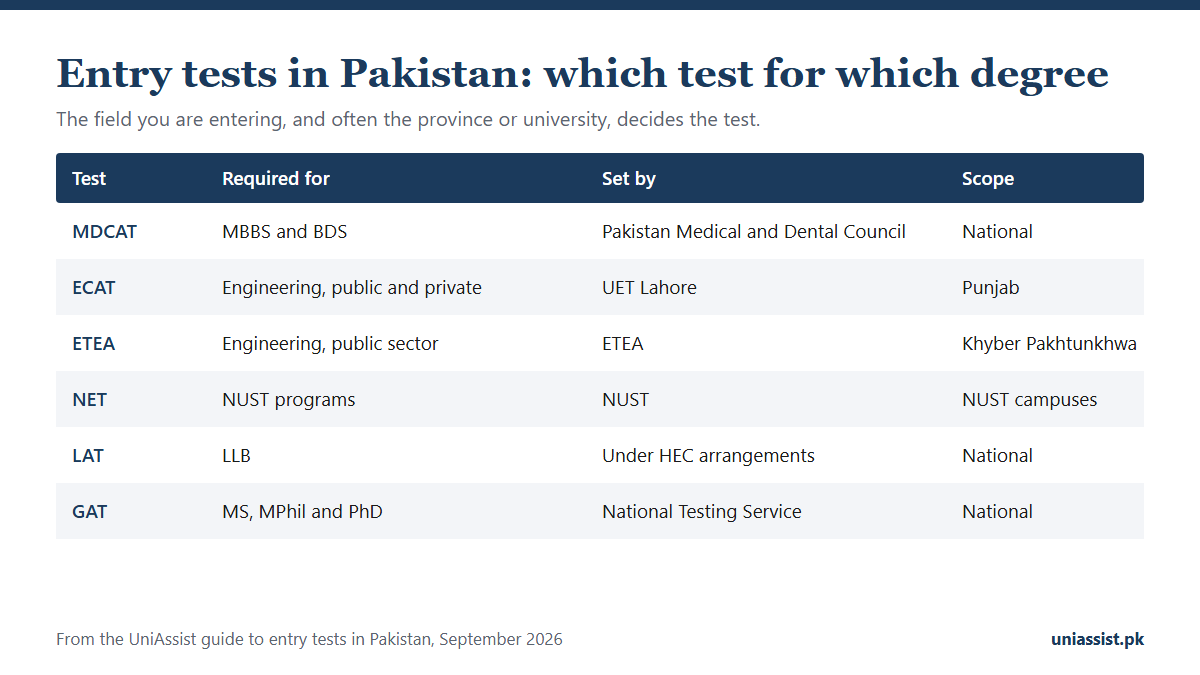
Entry tests in Pakistan, and what each one governs
| Test | Required for | Set by | Scope |
|---|---|---|---|
| MDCAT | MBBS and BDS | Pakistan Medical and Dental Council | National |
| ECAT | Engineering, public and private institutions | UET Lahore | Punjab |
| ETEA | Engineering and medical, public sector | Educational Testing and Evaluation Agency | Khyber Pakhtunkhwa |
| LAT | LLB | Administered under Higher Education Commission arrangements | National |
| GAT | MS, MPhil and PhD | National Testing Service | National |
| Institutional tests | Varies, for example NUST’s NET and comparable in-house tests | The university itself | One institution |
Medicine and dentistry: MDCAT
MDCAT is the route to an MBBS or BDS seat at public and private institutions alike; only seats reserved for foreign students and overseas Pakistanis can be filled on SAT-II, a foreign MCAT or UCAT instead. It is set nationally by PMDC, which fixes the structure through a Uniform MDCAT Curriculum: 180 multiple-choice questions over 3 hours, with no negative marking. The pass threshold differs by qualification: 55% for MBBS, 50% for BDS.
Our full MDCAT guide covers the subject weightings, difficulty distribution and eligibility rules in detail.
A figure worth correcting, because it is repeated constantly: the “200 marks, 60% to pass” that many candidates have heard describes the older PMC-era format and is out of date. The 60% that is still real refers to something else entirely: the minimum marks in HSSC or an equivalent qualification that PMDC’s regulations require for admission.
Allied-health and nursing programmes are governed separately. Nursing falls under the Pakistan Nursing and Midwifery Council, not PMDC, and does not use MDCAT.
Engineering: the test is provincial, the accreditation is not
Engineering admission runs on a provincial entry test: ECAT in Punjab, which PEC notifications make mandatory at public and private engineering institutions alike, an ETEA test for public sector admission in Khyber Pakhtunkhwa, and institution-set tests elsewhere. Our guide to engineering admission tests in Pakistan compares them. Private institutions frequently run their own.
The test gets you considered. What determines whether the degree is worth having is a separate question: Pakistan Engineering Council accreditation. PEC accredits a specific programme on a specific campus, so the same degree title can be accredited at one university and not at another, and graduating from a non-accredited engineering programme prevents PEC registration, which is what you need to practise as an engineer.
One distinction to get right before you apply anywhere. BE, BSc Engineering and BS Engineering are the same qualification; universities differ only in house style. Engineering technology is not. A B.Tech, or a degree titled “BS … Engineering Technology”, falls outside PEC’s definition of an engineering qualification. Because almost every award is now titled “BS”, the word that actually distinguishes them is Technology, not the prefix.
Law: the test is only half of it
Admission to an LLB requires the Law Admission Test in addition to the institution’s own criteria. But clearing it and graduating is not sufficient to practise: to appear in court you must be enrolled with a provincial Bar Council, and the Pakistan Bar Council recognises law colleges separately from the HEC’s recognition of the parent university. Confirm both before you enrol, not after.
Postgraduate: GAT, and what it is for
MS, MPhil and PhD admission generally requires the GAT, run by the National Testing Service, or an accepted institutional equivalent. Two structural points are worth knowing:
- MS and MPhil are equivalent. Both are two-year research master’s degrees and both qualify you to apply for a PhD. Departments choose between the titles by convention, not seniority.
- GAT scores have a validity period. Check that yours will still be current at the point of admission, not merely at the point you sat it.
Doctoral entry additionally depends on supervisor capacity: the Higher Education Commission caps how many candidates one supervisor may hold at a time, so meeting the threshold does not guarantee a place.
Institutional tests
Several universities run their own instead of, or alongside, the provincial test. NUST’s NET is the most widely sat (see our NUST NET guide), and typically runs in several series across a cycle, which means an early attempt can be followed by a second if the first goes badly. Where an institution accepts more than one test, check which it weights and how. The aggregate formula differs between universities, so the same two candidates can rank in a different order at two institutions.
What actually costs people places
With entry tests in Pakistan, the failure mode is rarely the test itself. It is documentation and timing:
- Equivalence certificates. A-Level and foreign-qualification holders need one from the Inter Board Coordination Commission before most institutions will process an application. It takes time. Start when results are published, not when you find the deadline.
- Domicile. Public-sector seats are allocated partly by domicile, so where your certificate was issued decides which quota you compete under. Open-merit seats for out-of-province applicants are limited.
- Registration windows. These close before the test date, sometimes well before, and are separate from the institution’s own admission deadline.
Confirm dates at source
Entry tests in Pakistan move their dates, and are occasionally rescheduled mid-cycle: a PMDC press release moved MDCAT 2026 from 16 August to 20 September 2026. Every figure in this guide that carries a number has been taken from the regulator’s own published document, but dates are the one thing that should always be checked against the administering body’s current notices before you plan around them.
Frequently Asked Questions
Which entry test do I need for medical college in Pakistan?
MDCAT, set by the Pakistan Medical and Dental Council. Passing it is mandatory for MBBS and BDS admission at public and private colleges alike; only seats reserved for foreign students and overseas Pakistanis can use SAT-II, a foreign MCAT or UCAT instead. Nursing and allied-health programmes are governed separately and do not use MDCAT.
Is there one entry test for all Pakistani universities?
No. The test depends on the field and often the province: MDCAT nationally for medicine and dentistry, ECAT in Punjab and ETEA in Khyber Pakhtunkhwa for public-sector engineering, LAT for law, GAT for postgraduate study, and institution-specific tests such as NUST's NET.
What is the difference between ECAT and MDCAT?
MDCAT is the national test for MBBS and BDS admission, set by PMDC. ECAT is the engineering entrance test conducted by UET Lahore; under PEC notifications it is mandatory for undergraduate engineering admission at both public and private engineering institutions. They cover different subjects and lead to entirely different programmes.
Do I need GAT for a master's degree in Pakistan?
Most institutions require the GAT or an accepted institutional equivalent for MS, MPhil and PhD admission. GAT scores carry a validity period, so confirm yours will still be current at the point of admission rather than when you sat it.
Does clearing an entry test guarantee admission?
No. Entry tests establish eligibility. Institutions then rank applicants on an aggregate that combines the test score with prior academic results, and public-sector seats carry a domicile component. Weightings differ between universities, so the same candidates can rank differently at two institutions.