The ETEA Engineering Entrance Test: Paper Composition and Eligibility
The ETEA engineering entrance test decides public sector engineering admission in Khyber Pakhtunkhwa, and is conducted by the Educational Testing and Evaluation Agency (ETEA). Unlike some conducting bodies, ETEA publishes the paper composition in advance, which means you can know exactly what you are sitting before you register.
Three test groups, not one paper
ETEA splits candidates into three groups by academic background. The group determines both the length of your paper and which subjects appear on it.
| Test group | Academic eligibility | MCQs |
|---|---|---|
| Pre-Engineering | Pre-Engineering; Pre-Medical with Additional Mathematics; A Level; Diploma of Associate Engineer (DAE); Bachelor of Technology (B.Tech) | 100 |
| Computer Science / Computer Studies | Computer Science / Computer Studies | 100 |
| Pre-Medical | Pre-Medical | 65 |
The eligibility column is worth reading twice. The Pre-Engineering group is not restricted to Pre-Engineering students: it explicitly admits Pre-Medical candidates who took Additional Mathematics, A Level candidates, DAE holders and B.Tech holders. Applicants from technical streams routinely assume the engineering route is closed to them, and on ETEA’s own criteria it is not.
What is on the ETEA engineering entrance test paper
The 100-MCQ paper is composed as follows:
| Subject | MCQs |
|---|---|
| Physics | 40 |
| Mathematics | 35 |
| English | 15 |
| Chemistry or Computer Science | 10 |
| Total | 100 |
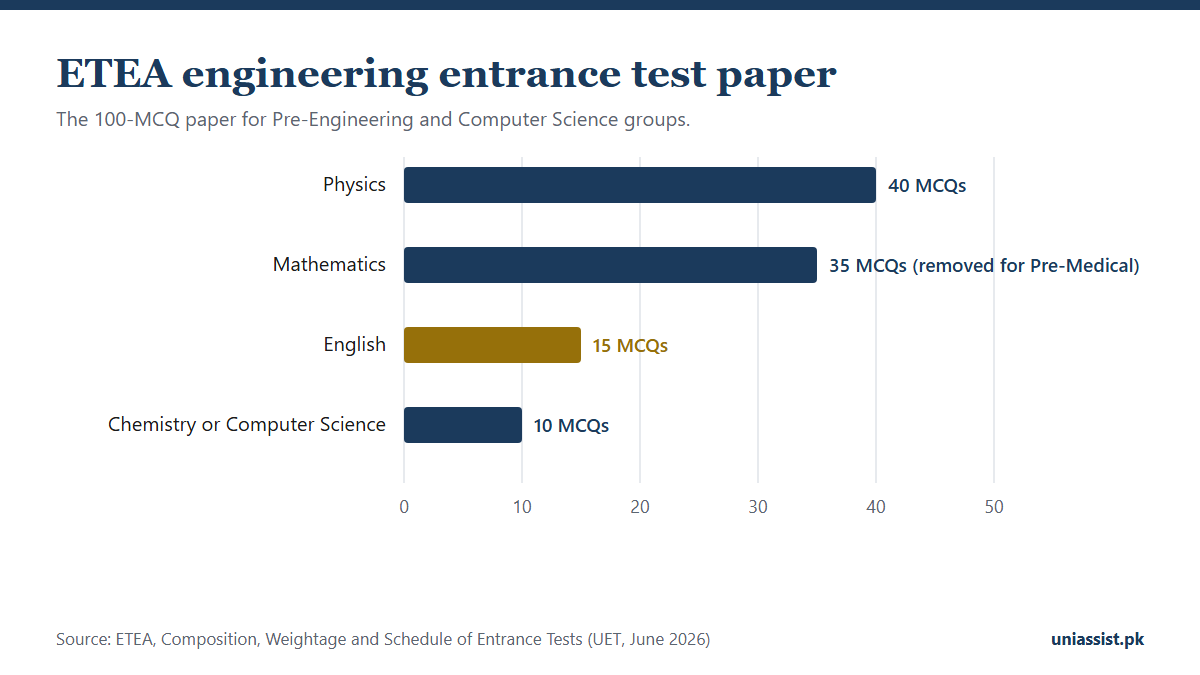
Two substitutions apply. For the Computer Science group, the 10 Chemistry MCQs are replaced by 10 Computer Science MCQs. For the Pre-Medical group, the 35 Mathematics MCQs are removed entirely, which is where the shorter 65-MCQ paper comes from.
What the weighting tells you about preparation
Physics and Mathematics together account for 75 of the 100 MCQs. Chemistry, which many candidates treat as a third pillar, is 10. English is 15, larger than Chemistry, and routinely the section applicants prepare least for.
For Pre-Medical candidates sitting the 65-MCQ version, the arithmetic shifts sharply: Physics is 40 of 65, or over 60% of the paper. A weak Physics section is close to unrecoverable on that version of the test.
Computer Science group candidates face the same balance as Pre-Engineering: only the final 10 MCQs change, so Physics and Mathematics still make up 75 of their 100 questions, and preparation should be weighted the same way.
Before you register for the ETEA engineering entrance test
ETEA runs tests for a range of institutions and departments, not only engineering, and publishes a separate course content notification for each. Confirm you are reading the one for the intake you are applying to. The composition above is from the UET notification for the June 2026 cycle.
Composition and eligibility are set by the conducting agency and can be revised between cycles, so check the current notification rather than working from last year’s.
Common questions
Is there negative marking?
ETEA’s course content notification sets out the number of MCQs per subject but does not state a marking scheme. Check the instructions issued with your admit card, or the notification for your specific test, before assuming either way.
Can I sit the Pre-Engineering paper as a Pre-Medical student?
Yes, if you took Additional Mathematics; that combination is listed under the Pre-Engineering group. Without it, you sit the 65-MCQ Pre-Medical paper.
Does a DAE let me into an engineering degree?
DAE is named in the Pre-Engineering group’s eligibility for the test itself. Whether a particular degree programme admits DAE holders, and on what seat quota, is set by the university, so confirm it with the institution before you register.
How many MCQs is the Computer Science paper?
100, the same as Pre-Engineering. The difference is the final 10 MCQs, which are Computer Science instead of Chemistry.
Sources
- Educational Testing and Evaluation Agency, Composition, Weightage and Schedule of Entrance Tests (UET, June 2026): course content notification
For how the ETEA engineering entrance test fits alongside ECAT and NUST’s NET, see our guide to engineering admission tests in Pakistan.