MDCAT 2026: Structure, Pass Marks and Eligibility Explained
The Medical and Dental College Admission Test (MDCAT) is the entry test for MBBS and BDS in Pakistan. It is set by the Pakistan Medical and Dental Council (PMDC), and passing it is a mandatory condition of admission to public and private medical and dental colleges alike. The exception is seats reserved for foreign students and overseas Pakistanis, which can be filled on SAT-II, a foreign MCAT or UCAT instead. Studying abroad is now a second exception: in October 2026 PMDC removed the MDCAT condition for admission to foreign medical and dental institutions, though its other requirements still apply. This guide sets out what MDCAT actually contains, what score you need, and where the commonly repeated figures are out of date.
The MDCAT format, as PMDC defines it
PMDC publishes a Uniform MDCAT Curriculum that fixes the structure nationally. Under the 2025 curriculum:
- 180 multiple-choice questions
- 3 hours duration
- Paper-based
- No negative marking: an unanswered question and a wrong answer score the same, so there is never a reason to leave a blank
MDCAT pass marks are not the same for MBBS and BDS
This is the detail most often stated wrongly, and it matters because it changes which qualification you are still in the running for:
- MBBS: 55% minimum
- BDS: 50% minimum
On a 180-question paper with no negative marking, 55% is 99 correct answers and 50% is 90. Clearing the test is a floor, not a placement: you then compete on aggregate merit against everyone else who cleared it, and the actual cut-off at a competitive public college sits far above the minimum.
If you have heard “200 marks and 60% to pass”
That figure circulates widely and it is no longer correct. It describes the earlier format used under the Pakistan Medical Commission, PMDC’s predecessor. The paper is now 180 questions, and the pass threshold is 55% for MBBS and 50% for BDS.
The 60% figure people remember is real, but it belongs to a different rule: it is the academic eligibility floor in HSSC or an equivalent qualification that PMDC’s admission regulations require before you can be admitted. Two separate requirements, frequently merged into one.
What the MDCAT paper covers
Weightings are fixed by the curriculum, so the balance does not change between centres or between years within the same curriculum:
| Subject | Weightage | Questions |
|---|---|---|
| Biology | 45% | 81 |
| Chemistry | 25% | 45 |
| Physics | 20% | 36 |
| English | 5% | 9 |
| Logical Reasoning | 5% | 9 |
| Total | 100% | 180 |
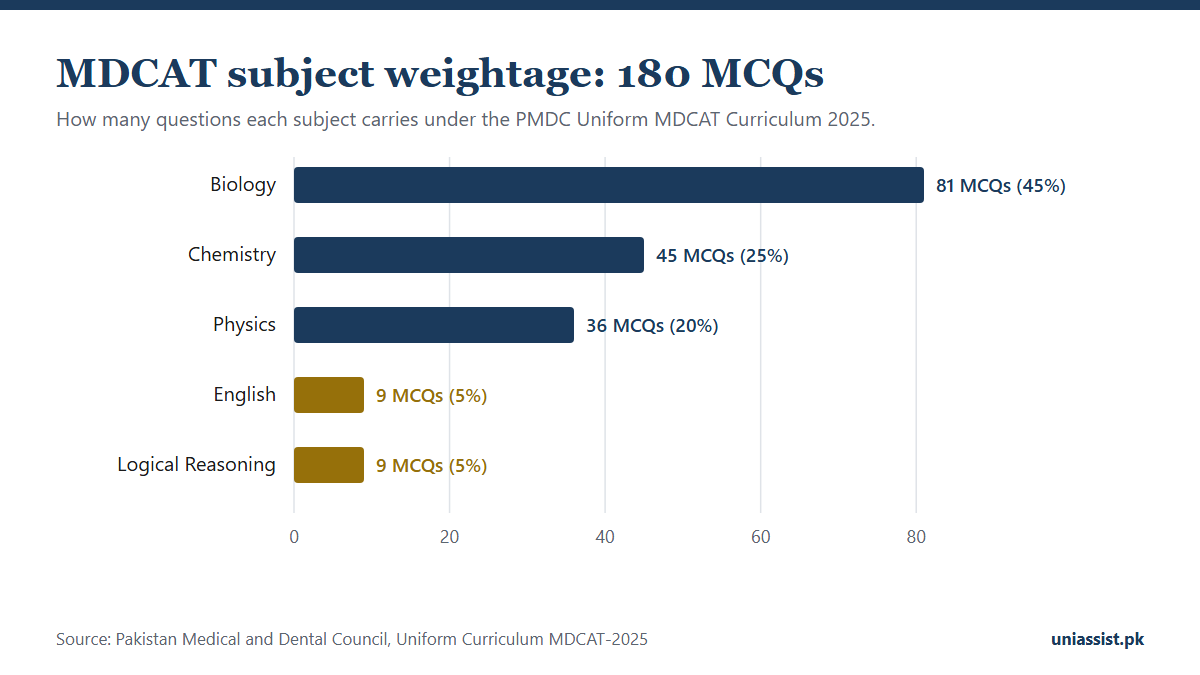
Biology alone is 45% of the paper, nearly as much as Chemistry and Physics combined. Candidates routinely divide preparation time evenly across the three sciences, which is a straightforward misallocation: an hour spent on Biology is worth more than twice an hour spent on Physics in pure mark terms.
English and Logical Reasoning are only nine questions each, but they are nine of the most reliably winnable marks on the paper. They need no syllabus recall, and at a 55% threshold, eighteen questions is a material part of the gap between clearing and not.
Difficulty is deliberately weighted
The curriculum specifies the difficulty distribution: 15% easy, 70% moderate, 15% difficult. That shape has a practical consequence. The difficult band, 15% of the paper, is not where the test is won. Securing the easy and moderate 85% is what clears the threshold comfortably; time spent in the hardest band during the exam is usually time taken from questions you would have got right.
MDCAT eligibility: the 60% HSSC rule
For admission you need at least 60% marks in HSSC or an equivalent 12th grade qualification recognised in Pakistan, with Biology and Chemistry as mandatory subjects and either Physics or Mathematics alongside them. Applicants holding A-Levels or a foreign qualification need an equivalence certificate from the Inter Boards Coordination Commission (IBCC) before their application can be processed. Start that as soon as results are published, because it is a common cause of missed deadlines rather than a formality.
After you clear MDCAT
A pass makes you eligible; it does not admit you. PMDC’s Admissions Regulations 2025 fix the merit formula for public and private colleges:
| Component | Weightage |
|---|---|
| MDCAT | 50% |
| F.Sc (Pre-Medical), HSSC or equivalent | 40% |
| SSC, Matriculation or equivalent | 10% |
Admitting universities then publish merit lists in sequence. Public-sector seats additionally carry a domicile component, so where your domicile certificate was issued affects which quota you compete under.
One check worth making before you accept any offer: confirm that the specific programme at the specific institution holds current PMDC recognition. Recognition is granted per programme and can lapse. A university being HEC-recognised is a separate matter and is not sufficient on its own.
Sitting a different route? Our overview of university entry tests in Pakistan sets out which test governs which degree.
Where to verify MDCAT dates
Test dates, registration windows and the curriculum itself are published by PMDC. Dates move: a PMDC press release moved MDCAT 2026 from 16 August to 20 September 2026, with all other terms unchanged. Treat any date you read anywhere else, including here, as needing confirmation against PMDC’s own notices before you plan around it.
Frequently Asked Questions
How many questions are in the MDCAT?
180 multiple-choice questions, to be completed in 3 hours. The paper is paper-based and carries no negative marking, so a wrong answer costs the same as a blank one.
What is the passing score for MDCAT?
55% for admission to MBBS and 50% for BDS. On a 180-question paper that is 99 and 90 correct answers respectively. Clearing the threshold only makes you eligible. Admission is then decided on aggregate merit, and competitive public colleges close far above the minimum.
Is the MDCAT 200 marks with 60% to pass?
No. That was the earlier format under the Pakistan Medical Commission and is now out of date. The paper is 180 questions and the pass mark is 55% for MBBS, 50% for BDS. The 60% figure refers to a different requirement: the minimum marks in HSSC or an equivalent qualification that PMDC requires for admission to a medical or dental college.
What subjects does MDCAT cover and how is it weighted?
Biology 45% (81 questions), Chemistry 25% (45), Physics 20% (36), English 5% (9) and Logical Reasoning 5% (9). Biology is nearly half the paper, so preparation split evenly across the three sciences under-weights the subject that carries the most marks.
Is there negative marking in MDCAT?
No. There is no penalty for a wrong answer, so every question should be attempted. Leaving one blank can only lose marks relative to guessing.
Does passing MDCAT guarantee admission to a medical college?
No. It establishes eligibility. Under PMDC's regulations merit is then calculated as 50% MDCAT, 40% HSSC or equivalent and 10% SSC or equivalent, with public-sector seats also allocated partly on domicile. Confirm too that the specific programme holds current PMDC recognition, which is separate from the university being HEC-recognised.