PMDC Removes MDCAT Condition for MBBS, MD and BDS Admissions Abroad
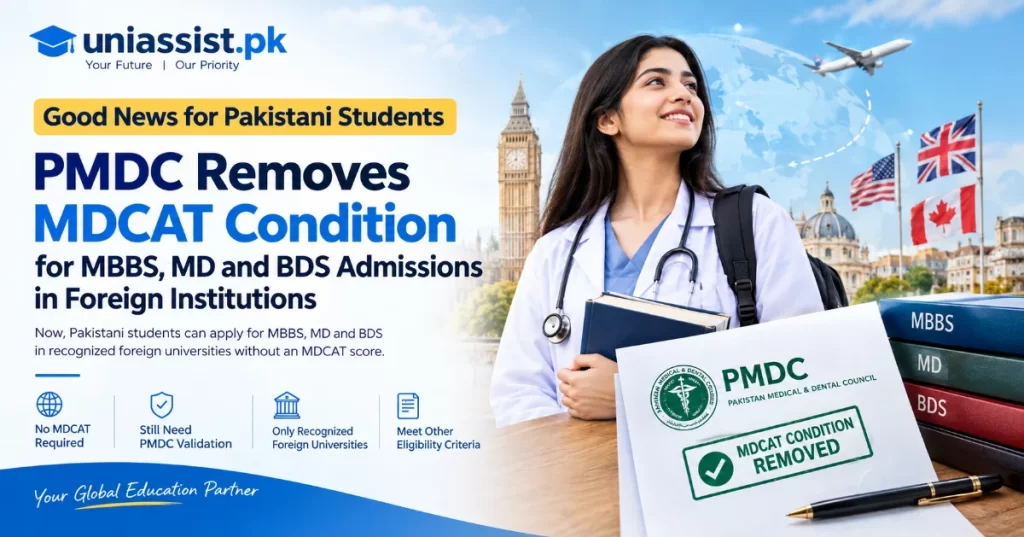
The Pakistan Medical & Dental Council has removed the MDCAT requirement for MBBS abroad, and for dentistry with it. The decision was taken at the Council’s meeting of 14 September 2026 and issued as a public notice on 5 October 2026, covering Pakistani students seeking admission to foreign medical and dental institutions.
The notice is four lines long, and this is all of it:
It is informed to all concerned that the PM&DC Council, in its meeting held on 14th September 2026, has decided to exempt the mandatory requirement of having passed the MDCAT as a pre-requisite for Pakistani students seeking admission into foreign medical and dental institutions.
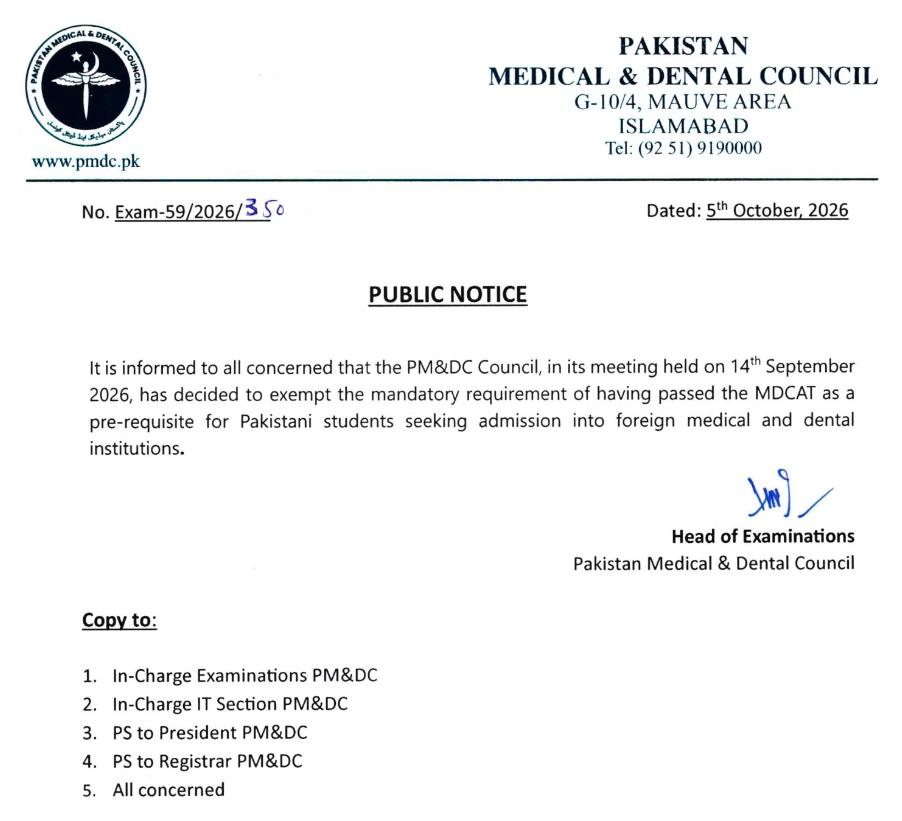
That is the whole change. The MDCAT requirement for MBBS abroad is lifted, and that is the only condition the notice touches. Nothing else in the policy governing foreign medical study has been altered, and the conditions that decide whether your degree will count in Pakistan are untouched — including one that PM&DC has said in writing it will not relax for anybody.
What the MDCAT requirement for MBBS abroad used to be
PM&DC’s policy for Pakistani students seeking admission to foreign undergraduate medical and dental institutions was notified on 29 July 2024 and took effect from Session 2024-25. Among its mandatory conditions was this one:
The student must have obtained 50% marks in MDCAT conducted in Pakistan. Subject result shall be valid for three (3) years (applicable for students who complete their intermediate education within Pakistan).
PM&DC restated that requirement as recently as 14 May 2026, in a public notice numbered Exam-59/2026/319. The exemption notice is numbered Exam-59/2026/350 — the same file series, five months later. That is the condition now gone.
If you completed your intermediate education outside Pakistan, the MDCAT condition never applied to you in the first place; the alternative qualifications below did.
What has not changed
The 2024 policy sets out the conditions to be met before admission to a foreign medical or dental institution. Dropping the MDCAT requirement for MBBS abroad leaves every one of them standing:
- FSc (Pre-Medical) with at least 60% marks, for students who completed intermediate education in Pakistan. Alternatively, SAT-II with a minimum of 550 in each subject, or a foreign MCAT or UCAT with 50% marks in Biology, Chemistry and either Mathematics or Physics.
- The institution must appear on the list held by PM&DC.
- The qualification must be in allopathic medicine, awarded by an institution that its own country’s regulator recognises for full registration, and that is accredited by the WFME or listed in the World Directory of Medical Schools.
- A PM&DC Student Registration Certificate, obtained before you accept the place — not after you arrive, and not after you graduate. Registration is done through the council’s student portal at srf.pmdc.pk.
- At least 6,200 teaching hours over five years, with a minimum of 80% attendance.
- At least six months learning the local language before departure, where the medium of education is not English.
- The National Registration Examination (NRE) after qualifying, to obtain full registration with PM&DC.
- Residence details and contact numbers in the country of study, provided before you go.
- A multiple-entry visa covering the duration of the degree, before you go.
A 14 May 2026 public notice adds that online registration is mandatory to become eligible for provisional registration and for the NRE under the PM&DC Act, 2022.
The condition that decides whether your degree will ever count
This is the part that matters most, and it is not affected by the MDCAT exemption.
On 31 July 2026, PM&DC issued notification PF-5-ADR-PM&DC/2026/1220, restating a Council decision of 24 July 2025: only Pakistani nationals whose primary medical or dental qualification comes from a foreign institution recognised by the Education Commission on Foreign Medical Graduates (ECFMG) may sit the NRE.
No NRE means no full registration, and no registration means no practice in Pakistan. The degree still exists; it just does not lead anywhere here.
The same notice names a live example. Medical and dental institutions in Afghanistan are not currently included among ECFMG-recognised institutions, so their graduates are not eligible to sit the NRE and are not entitled to register with PM&DC. The council put its position on relaxations plainly:
PM&DC shall not entertain any request for exemption, relaxation, or special dispensation from the prescribed eligibility requirements.
So the order of checks matters. The MDCAT requirement for MBBS abroad is gone, which removes a barrier to getting in. ECFMG recognition remains the barrier to coming back. Check the second one before you pay anybody.
Does this cover BDS as well as MBBS?
Yes. The notice says “foreign medical and dental institutions”, so it covers dentistry as well as medicine. The rest of the policy applies to both too — the 2024 notification is titled “Policy for Students seeking Admissions in Undergraduate Medical / Dental Foreign Institutes”.
If you are weighing the two, our pages on MBBS in Pakistan and BDS in Pakistan set out what each degree involves and which universities offer it here.
What about MD programmes?
Be careful with this one, because “MD” means different things in different countries.
In the United States, Canada and some other systems, MD is the entry-level medical qualification, roughly equivalent to MBBS — but it is usually entered after a bachelor’s degree rather than straight after intermediate. In Pakistan and much of the Commonwealth, MD is a postgraduate degree taken after MBBS.
PM&DC’s policy, and the exemption, concern admission to undergraduate medical and dental education. Before applying to anything labelled MD, confirm which of those two things it is, and whether the programme admits students directly from FSc Pre-Medical.
What the notice does not say
Worth being straight about the limits of a four-line notice. It lifts the MDCAT requirement for MBBS abroad and says nothing else: it does not state which admission session the exemption takes effect from, it attaches no conditions, and it says nothing about any other requirement. It removes one pre-requisite and stops there.
If your admission depends on the timing, ask PM&DC directly rather than asking a consultant, and keep the reply.
Before you pay anyone: a short checklist
- Confirm the exact institution. Full legal name and campus — not a similarly named affiliate or branch.
- Check ECFMG recognition for that institution, because the NRE depends on it.
- Check it against PM&DC’s own list of foreign institutions.
- Confirm your academic eligibility — 60% in FSc Pre-Medical, or the SAT-II / foreign MCAT / UCAT alternative. If you hold A-Levels or a foreign qualification, start your IBCC equivalence early; it is a common reason applications stall.
- Complete PM&DC student registration at srf.pmdc.pk before you accept the place.
- Check the programme’s structure against 6,200 hours over five years with 80% attendance.
- Get the total cost in writing — the whole degree, not the first year — along with the refund policy if registration is refused.
- Keep every document. Admission letter, registration certificate, transcripts, attendance and rotation records. You will need them at registration, years later.
Verbal assurance from an agent is worth nothing at the registration counter. Neither is a university’s presence in an international directory, by itself — the policy requires recognition by the home regulator for full registration, plus WFME accreditation or a World Directory listing, plus ECFMG recognition for the NRE.
If you were counting on MDCAT
Dropping the MDCAT requirement for MBBS abroad widens one route. It does not make foreign study the right route for everyone, and studying abroad is more expensive than a public-sector seat in Pakistan.
If you are still deciding, which field is best after FSc Pre-Medical compares the options with and without MDCAT, and our MDCAT guide covers the structure, pass marks and eligibility rules for admission here. Students who want a health-sector career without MDCAT often look at Pharm-D and DPT, both of which admit on FSc Pre-Medical.
Official sources
- Public Notice Regarding Exemption of MDCAT for seeking Admission in Foreign Institutions — No. Exam-59/2026/350, 5 October 2026
- Policy for Students seeking Admissions in Undergraduate Medical / Dental Foreign Institutes — No. 1-C/Council/2024/515, 29 July 2024
- Eligibility of Pakistani Nationals Graduating from Foreign Medical and Dental Institutions for the NRE — No. PF-5-ADR-PM&DC/2026/1220, 31 July 2026
- Public Notice Regarding Students Seeking Admissions in Foreign Institutions — No. Exam-59/2026/319, 14 May 2026
- PM&DC Public Announcements and Institutions & Qualifications
- PM&DC Student Registration Portal — srf.pmdc.pk
Fees, recognition lists and licensing rules change. Check the council’s announcements page before you commit money to a university or an agent.
Frequently Asked Questions
Has PMDC removed the MDCAT requirement for MBBS abroad?
Yes. A PM&DC public notice dated 5 October 2026 (No. Exam-59/2026/350) records that the Council, at its meeting of 14 September 2026, decided to exempt the mandatory requirement of having passed the MDCAT as a pre-requisite for Pakistani students seeking admission into foreign medical and dental institutions.
Can I study MBBS abroad without MDCAT now?
Yes, so far as PM&DC is concerned: the MDCAT requirement for MBBS abroad has been lifted, and it is no longer a pre-requisite for admission to a foreign medical or dental institution. You still have to meet the rest of the council's conditions, and the foreign university will apply its own admission criteria, which may include its own entrance test.
Does the MDCAT exemption apply to BDS as well?
Yes. The notice covers admission to foreign medical and dental institutions, so the MDCAT requirement for MBBS abroad and for BDS abroad has been lifted in the same sentence.
Is FSc Pre-Medical still required for MBBS abroad?
Yes. PM&DC's policy requires FSc (Pre-Medical) with at least 60% marks for students who completed intermediate education in Pakistan. The alternative is SAT-II with at least 550 in each subject, or a foreign MCAT or UCAT with 50% marks in Biology, Chemistry and either Mathematics or Physics.
Do I still need PMDC registration before going abroad?
Yes. The policy requires a PM&DC Student Registration Certificate before you accept studies at a foreign institution. Registration is done through the council's student portal at srf.pmdc.pk, and it is what makes you eligible later for provisional registration and the National Registration Examination.
Can I now choose any foreign medical university?
No, and this is the condition that matters most. Only graduates of foreign institutions recognised by the ECFMG may sit the National Registration Examination, and without the NRE there is no full registration to practise in Pakistan. PM&DC has stated that it will not entertain any request for exemption, relaxation or special dispensation from these eligibility requirements.
Can Pakistani students study medicine in Afghanistan?
They can enrol, but PM&DC has stated that medical and dental institutions in Afghanistan are not currently included among ECFMG-recognised institutions. Graduates of those institutions are therefore not eligible to sit the National Registration Examination and are not entitled to register with PM&DC to practise in Pakistan.
Will I still have to pass the NRE after completing MBBS abroad?
Yes. The National Registration Examination is unchanged. MDCAT governs admission; the NRE governs registration and licensing for foreign graduates. An exemption from one is not an exemption from the other.
How long must the foreign degree be?
PM&DC requires the medical qualification to comprise at least 6,200 hours over five years, with a minimum of 80% attendance. Where the medium of instruction is not English, the policy also requires at least six months learning the local language before you travel.
Which admission session does the exemption apply from?
The notice does not say. It states the exemption without naming an effective session or attaching conditions. If your admission depends on the timing, ask PM&DC directly and keep the written reply.