Which Field Is Best After FSc Pre-Medical in Pakistan? Options With and Without MDCAT
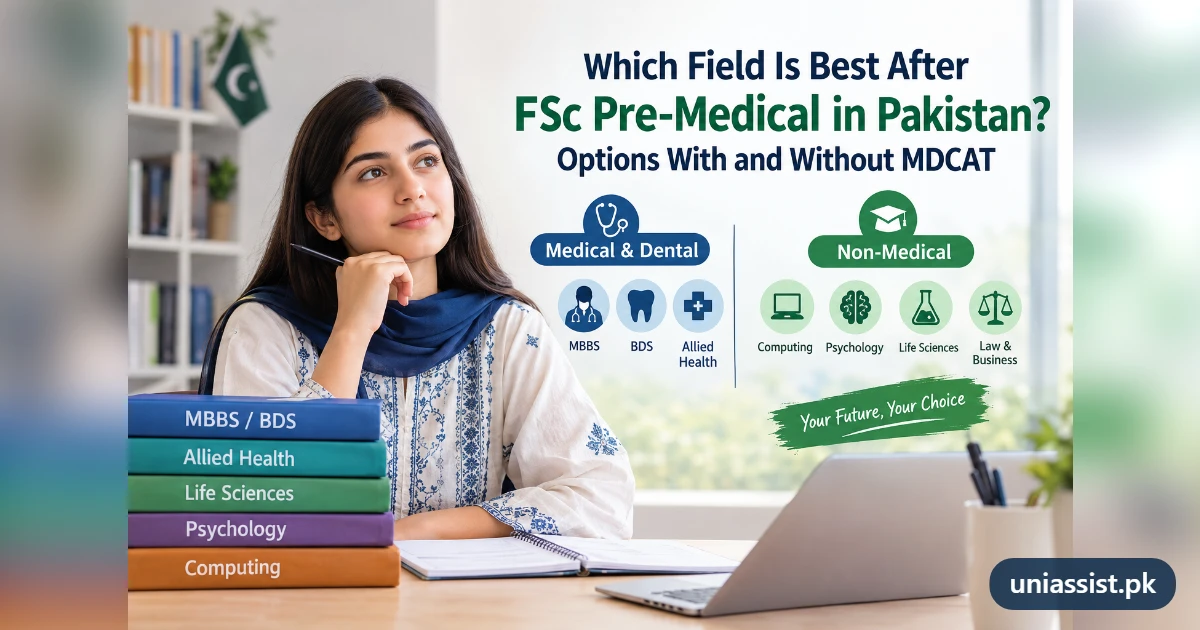
Completing FSc Pre-Medical does not mean MBBS or BDS are your only choices. You can enter medicine and dentistry through MDCAT, and you can also choose allied health, pharmacy, nursing, life sciences, psychology, computing, business or law.
The real question is not simply which is the best field after FSc pre-medical in Pakistan. It is which field fits your marks, your MDCAT result, your budget, your interests and the work you want to do after graduation.
How to decide the best field after FSc pre-medical in Pakistan
The best field after FSc pre-medical in Pakistan depends on four things: your MDCAT position, your FSc marks, your budget and your career interests. If MBBS or BDS is the goal, MDCAT and merit decide it. If you would rather not sit MDCAT, nursing, pharmacy, allied health, psychology, life sciences and some computing degrees stay open.
A missed MDCAT does not end your education. It changes the set of realistic options.
Before choosing a degree, check five things:
- Eligibility. Does the university accept FSc Pre-Medical students for this degree?
- MDCAT or entry test. Is MDCAT required by law, or does the university use its own test?
- Professional recognition. Does the degree lead to registration with a professional council?
- Total cost. What will the whole degree cost, not just the first semester?
- Career direction. What work can you realistically do after graduation?
For medical and dental programs, PMDC’s Admissions Regulations 2025 require MDCAT, at least 60% in HSSC or an equivalent qualification, and Biology and Chemistry as mandatory subjects with either Physics or Mathematics alongside them.
For everything else, the rules are set by the university, the relevant council, or HEC’s curriculum for that discipline.
At a glance: which fields need MDCAT
There is no single best field after FSc pre-medical in Pakistan, so start by separating the degrees that legally require MDCAT from the ones that do not.
The table separates the national rule from university entry tests. “No” means there is no national MDCAT requirement for that degree. It does not mean a university will admit you without any test. Salary figures are Indeed averages for the job title, not for graduates of the degree, and all were checked on 28 September 2026.
| Field | MDCAT required | Typical duration | Main regulator | Universities on UniAssist | Salary evidence |
|---|---|---|---|---|---|
| MBBS | Yes | 5 years | PMDC | Merit decided by MDCAT and academic record | Varies by employer and BPS |
| BDS | Yes | 4 years | PMDC | Same national route as MBBS | Varies by employer |
| DPT | No national requirement | 5 years | AHPC and the university | 6 | Rs 37,286 a month, 48 salaries, updated 10 September 2026 |
| Pharm-D | No national requirement | 5 years | Pharmacy Council of Pakistan | 5 | Rs 47,039 a month, 185 salaries, updated 16 September 2026 |
| BS Nursing | No national requirement | 4 years | PNMC | 17 | Rs 58,091 a month, 67 salaries, updated 15 September 2026 |
| Medical Laboratory Technology | No national requirement | 4 years | AHPC | 26 | Depends on role and employer |
| Medical Imaging Technology | No national requirement | 4 years | AHPC | 6 | Depends on role and employer |
| Optometry | No national requirement | 4 years | AHPC and the university | 5 | Rs 40,902 a month, only 5 salaries, updated 8 January 2026 |
| Nutrition and Dietetics | No national requirement | 4 years | HEC and the university | 29 | Rs 41,984 a month, 25 salaries, updated 24 August 2026 |
| BS Psychology | No | 4 years | HEC and the university | 39 | Rs 45,308 a month, 19 salaries, updated 16 September 2026 |
| BS Computer Science | No, but the mathematics rule applies | 4 years | HEC and NCEAC | 76 | Rs 94,072 a month for software engineers, 410 salaries, updated 18 September 2026 |
| BS IT | No, but the mathematics rule applies | 4 years | HEC and NCEAC | 31 | Varies by role |
| BBA | No | 4 years | HEC and the university | 44 | Varies by role |
| LLB | No, but the LAT applies | 5 years | HEC and the Pakistan Bar Council | 14 | Varies by role |
UniAssist lists 279 universities, 1831 programs and 4660 recorded offerings, with admission and fee information where the university publishes it.
Medical and dental: MBBS and BDS
For many FSc Pre-Medical students, MBBS is the original goal.
MBBS
MBBS is a five-year professional degree, and admission is regulated nationally by the Pakistan Medical and Dental Council.
Under PMDC’s Admissions Regulations 2025, you must pass MDCAT, hold HSSC or an equivalent 12th grade qualification with at least 60% marks, and have passed Biology and Chemistry, plus either Physics or Mathematics. MDCAT is not just another university entrance test here. It is part of the national eligibility rules.
Merit matters as much as eligibility. The same regulations set merit for public and private colleges at 50% MDCAT, 40% HSSC and 10% SSC.
Read our MDCAT guide for the paper, pass marks and eligibility rules, then work out your aggregate on the merit calculator before deciding whether to apply, repeat MDCAT or change direction.
BDS
BDS is the dental degree and PMDC regulates it the same way, so it is not the no-MDCAT alternative that students sometimes assume.
The useful distinction is between medical and dental degrees, which require MDCAT, and the much wider group of health degrees, which do not.
Allied health fields after FSc pre-medical
Allied health suits you if you want to work in healthcare without becoming a doctor or dentist.
The Allied Health Professionals Council regulates these professions and keeps the register. Since 21 March 2025 it accepts registrations only through its online portal, and institutions have had to register online since 10 March 2026. Check that the specific program at the specific institution is recognized before you pay anything.
DPT
Doctor of Physical Therapy is generally a five-year professional degree. Physiotherapists work with patients recovering from injuries, neurological conditions and movement disorders, in hospitals, rehabilitation centers, sports facilities, private clinics and home care.
There is no national MDCAT requirement for DPT, but universities set their own admission tests and merit rules. UniAssist records DPT at 6 universities.
On salary, be careful. Indeed’s Pakistan physiotherapist page shows an average of Rs 37,286 a month from 48 reported salaries, updated 10 September 2026.
See DPT universities and fees for the current list.
Pharm-D
Pharm-D is a five-year degree covering medicines, pharmaceutical sciences, drug safety and pharmacy practice. Graduates work in manufacturing, quality assurance and control, regulatory affairs, hospital and community pharmacy, sales and marketing, and research.
To practice as a pharmacist you must register with the Pharmacy Council of Pakistan and the relevant provincial council.
Indeed reports an average pharmacist salary of Rs 47,039 a month from 185 reported salaries, updated 16 September 2026.
See Pharm-D universities and fees, where UniAssist records 5 universities.
BS Nursing
Generic BSN is a four-year degree and one of the clearest healthcare routes that does not need MDCAT.
The Pakistan Nursing and Midwifery Council’s admission criteria list Generic BSN and BSM as four-year degree programs and require FSc Pre-Medical or equivalent with at least 50% marks, having studied Biology. Nursing is a regulated profession, so check that the institute holds current PNMC recognition before you enroll.
Indeed’s Pakistan nurse page shows an average of Rs 58,091 a month from 67 reported salaries, updated 15 September 2026.
See BS Nursing universities and fees, with 17 universities recorded.
Medical laboratory technology
This suits students drawn to diagnostics rather than direct treatment. Programs cover areas such as clinical chemistry, hematology, microbiology, pathology and laboratory procedures, and graduates work in hospital labs, diagnostic centers and research laboratories.
UniAssist records BS Medical Laboratory Technology at 26 universities. Confirm the program’s AHPC registration route before enrolling.
Medical imaging and radiology
Medical imaging focuses on diagnostic imaging rather than laboratory testing, covering radiographic procedures, imaging equipment, patient positioning and radiation safety. UniAssist records BS Medical Imaging Technology at 6 universities.
Optometry
Optometry is vision and eye care, in hospitals, eye clinics and optical practices. Indeed reports an average optometrist salary of Rs 40,902 a month, but from only five reported salaries, updated 8 January 2026, so treat it as a weak signal rather than a starting salary. UniAssist records BS Optometry at 5 universities.
Nutrition and dietetics
Human nutrition and dietetics suits students who like biology but are more interested in food, health and disease prevention. Work settings include hospitals, clinics, food companies, public health projects and private practice.
Indeed reports an average nutritionist salary of Rs 41,984 a month from 25 reported salaries, updated 24 August 2026. UniAssist records BS Human Nutrition and Dietetics at 29 universities.
Anesthesia and operation theatre technology
These programs support surgical and procedural teams and suit students who prefer practical hospital work. UniAssist records BS Anesthesia Technology and BS Operation Theatre Technology as four-year degrees.
For these degrees especially, the question is not whether a university offers the program. Check its current recognition, clinical training arrangements and registration route first.
Life sciences after FSc pre-medical
Not every biology career leads to patient care. If you prefer scientific investigation to clinical practice, life sciences are a different route.
Biotechnology
Biotechnology combines biology with laboratory science and technology, leading towards research, molecular biology, pharmaceuticals, agriculture, food science and diagnostics. Postgraduate study matters for research careers. UniAssist records BS Biotechnology at 37 universities.
Microbiology
Microbiology covers microorganisms in health, disease, food, industry and the environment, and leads towards laboratory work, quality control, the food and pharmaceutical industries and research. UniAssist records BS Microbiology at 19 universities.
Biochemistry
Biochemistry sits between biology and chemistry and suits students who want to understand biological processes at the molecular level, in laboratories, research, pharmaceuticals and academia. UniAssist records BS Biochemistry at 21 universities.
Zoology, botany and genetics
Zoology and botany remain options for students interested in animal and plant sciences, ecology, agriculture and conservation. Genetics is more specialized and leads towards molecular biology, genomics and research.
These degrees are not regulated as clinical professions the way MBBS, nursing or pharmacy are, so your university, laboratory exposure, internships and postgraduate plans carry more weight.
Psychology and other fields
BS Psychology
Psychology suits students interested in human behavior, mental processes, education, organizational work and research. It is generally a four-year degree, and UniAssist records BS Psychology at 39 universities.
A bachelor’s degree does not make you a clinical psychologist. Clinical practice needs postgraduate qualifications and supervised training, so separate studying psychology from becoming a licensed practitioner.
Indeed reports an average psychologist salary of Rs 45,308 a month from 19 reported salaries, updated 16 September 2026.
BBA
If your interests have moved from science to business, BBA is open at universities that accept intermediate qualifications broadly, and UniAssist records it at 44 of them. It leads towards marketing, finance, human resources, operations and management.
The advantage is flexibility. The drawback is that your FSc background gives you no head start, so internships and analytical skills matter more.
LLB
LLB is a five-year degree and needs the Law Admission Test rather than MDCAT. Clearing it and graduating is not enough to appear in court: you must enroll with a provincial bar council, and the Pakistan Bar Council recognizes law colleges separately from HEC’s recognition of the university. Our guide to entry tests in Pakistan covers the LAT alongside the other tests.
Computing after pre-medical
Computing is open to FSc Pre-Medical students, and the catch is mathematics.
Can you do BSCS after FSc pre-medical?
Yes, subject to a national rule. HEC’s BS Computer Science curriculum sets the entry requirement for all BS computing programs as HSSC, A Level or an IBCC equivalent with at least 50% marks and mathematics. It then adds the route that matters for pre-medical students: those who did not study mathematics at intermediate level must pass deficiency courses in mathematics worth six credit hours in the first year, including a zero semester. Universities can also require their own entry test.
So a pre-medical background does not close computing off, but it adds coursework. Do not rely on a general claim that “pre-medical students can do BSCS”. Read the admission criteria for the exact university and intake, because some universities apply the deficiency route and others ask for mathematics before admission.
UniAssist records BS Computer Science at 76 universities, BS IT at 31 and BS Artificial Intelligence at 45.
BSCS or BS IT?
BSCS gives a broad computing foundation across programming, algorithms, databases, operating systems and computer systems. BS IT leans towards applied information technology and infrastructure. Our guide to BSCS scope in Pakistan covers pay, employers and specializations in detail.
Pay in software is different from most health degrees. Indeed reports an average software engineer salary of Rs 94,072 a month from 410 reported salaries, updated 18 September 2026. That measures software engineering jobs, not what a new graduate is offered, so read it as a market signal.
The real question is not whether a pre-medical student can enter computing. It is whether you are willing to learn mathematics, programming and technical problem-solving.
Degrees that lead to a license, and degrees that do not
This distinction decides more about your career than any salary table, and most lists of fields after FSc pre-medical skip it.
Some degrees are gateways to a regulated profession. You cannot legally practice until a council registers you, and the council also decides which institutions it recognizes. Medicine and dentistry run through PMDC, nursing through PNMC, pharmacy through the Pharmacy Council of Pakistan and the provincial councils, allied health professions through the Allied Health Professionals Council, and law through the Pakistan Bar Council for anyone who wants to appear in court.
Two things follow. First, a degree from an institution the council does not recognize can leave you unable to register, whatever the university’s own prospectus says. Second, recognition is granted per program and per institution, and it can lapse, so an old brochure or a senior’s advice from three years ago is not evidence.
Other degrees, including life sciences, psychology at bachelor’s level, business and computing, are not licensed professions. Nobody will stop you working after graduation, and no register protects the job title either. Your university’s reputation, your internships, your projects and any postgraduate study carry the weight instead.
Neither group is better. They fail differently. A regulated degree from an unrecognized institution wastes years. An unregulated degree with no practical skills leaves you competing with every other graduate who also has only a transcript.
What to do in the weeks after your FSc result
Most students lose options to deadlines rather than to marks, so work through this in order:
- Write down your aggregate. For medical and dental admission that is 50% MDCAT, 40% HSSC and 10% SSC. The merit calculator does the arithmetic for the formulas it supports.
- Check the registration windows, not just the admission deadlines. Entry test registration closes well before the test, and the test sits well before the university’s own deadline.
- Get your equivalence early if you hold A Levels or a foreign qualification. IBCC equivalence takes time and is a common reason applications stall.
- Confirm your domicile position. Public sector seats carry a domicile component, so where your certificate was issued decides which quota you compete under.
- Build a three-tier shortlist. One ambitious program, two or three where you clearly meet the threshold, and one you can certainly afford.
- Check recognition for every regulated degree on the list, at the specific institution, for the intake you are applying to.
Low marks or a missed MDCAT
Students searching for fields after FSc pre-medical with low marks often assume low marks rule out every professional degree. They do not. What matters is how low, and against which university’s threshold.
PNMC, for example, sets 50% in FSc Pre-Medical for Generic BSN, well below the 60% PMDC requires for MBBS and BDS. Other disciplines set their own thresholds.
If your marks are short of your preferred program, three paths are worth considering.
First, apply where you actually meet the threshold. Build a list with ambitious, realistic and affordable choices rather than applying only to the most competitive universities.
Second, consider a second MDCAT attempt if medicine is still the goal. Base that on your academic record, your preparation and whether you can afford another admission cycle.
Third, look at medicine abroad, carefully. PMDC removed the MDCAT condition for admission to foreign medical and dental institutions in October 2026, so a missed MDCAT no longer closes that door. It does not open it either: the council still requires 60% in FSc Pre-Medical, registration before you travel, and a degree from an ECFMG-recognised institution, without which you cannot sit the exam that leads to registration in Pakistan.
Fourth, separate wanting healthcare from wanting to be a doctor. If the real interest is patient care, medicines, rehabilitation or diagnostics, several professions deliver that without MBBS.
What it costs
There is no single fee after FSc Pre-Medical. Costs vary between public and private universities and between campuses of the same institution.
As one example from the directory, Benazir Bhutto Shaheed University Lyari records a per-semester fee of Rs 69,000 for both Pharm-D and DPT, and Rs 31,000 per semester for BS Computer Science, for 2026. Those are figures for one public university, not national averages.
Before applying, add up the admission fee, tuition per semester, examination and registration charges, laboratory charges, the security deposit, transport, hostel, books and equipment, and any clinical training costs. The cheapest first semester is not always the cheapest degree.
Armed forces medical routes
If you are interested in a military medical career, separate ordinary civilian admission from the medical cadet route.
For 2026-27, the National University of Medical Sciences conducts the NUMS MDCAT for MBBS and BDS admission at its constituent, affiliated and all military-administered medical and dental colleges. Army Medical College, Rawalpindi appears in that list for medical cadets only, and the test was held on 23 August 2026 for that session.
Medical cadets are selected to serve in the armed forces medical services, and selection adds army recruitment testing, medical examination, physical and psychological assessment and an interview to the entry test. Read the current year advertisement rather than assuming civilian and cadet admission work the same way.
Jobs after FSc pre-medical in Pakistan
FSc Pre-Medical on its own is not a professional qualification for skilled healthcare jobs. The step that matters is from FSc to a recognized degree and, where the profession is regulated, registration with its council.
After the relevant degree and registration, the roles include doctors, dentists, physiotherapists, pharmacists, registered nurses, laboratory and imaging professionals, optometrists, nutritionists, psychologists, biotechnologists and microbiologists, researchers, software and IT professionals, business roles after BBA and legal practice after LLB.
Keep private and government pay separate. Job board averages describe private employers, while a government post is paid on its Basic Pay Scale plus allowances, as set out in the advertisement for that post. A private pharmacist average and a BPS-17 government pharmacist position are not comparable numbers.
Matching the best field after FSc pre-medical to your situation
If you want to be a doctor: focus on MDCAT, the 60% HSSC rule, merit and the cost difference between public and private medical colleges.
If you want healthcare but not MBBS: look at DPT, Pharm-D, BS Nursing, medical laboratory technology, medical imaging, optometry and nutrition.
If you like biology and laboratory work: look at biotechnology, microbiology, biochemistry and genetics.
If you are interested in human behavior: consider BS Psychology, then the postgraduate route if you want to practice.
If technology interests you: check which universities admit pre-medical students to BSCS, BS IT or BS AI, and plan for the mathematics deficiency courses.
If your marks are low: start from eligibility rather than prestige, then compare fees, recognition and career outcomes.
The bottom line
The best field after FSc pre-medical in Pakistan is the one you can get into, afford and finish. FSc Pre-Medical gives you a far wider starting point than MBBS alone. If your MDCAT result and academic record support it, MBBS and BDS remain strong options. If not, nursing, pharmacy, physiotherapy, laboratory technology, imaging, optometry and nutrition are professional healthcare routes that do not need MDCAT, and psychology, life sciences, business, law and computing sit outside healthcare entirely.
Stop treating the decision as “MBBS or nothing”. Compare each field on eligibility, MDCAT requirement, professional recognition, total cost, duration and the work you would actually do. Then check the university-specific options on UniAssist program pages and estimate your position with the merit calculator.
Frequently Asked Questions
Which fields can I choose after FSc pre-medical without MDCAT?
You can consider BS Nursing, Pharm-D, DPT, medical laboratory technology, medical imaging, optometry, nutrition, psychology, life sciences, business, law and, where the university allows it, computing degrees such as BSCS and BS IT. Entry tests and minimum marks can still apply. PMDC's MDCAT requirement covers undergraduate medical and dental admission only.
Can I do BSCS or BS IT after FSc pre-medical?
Yes. HEC's computing curriculum requires at least 50% marks and mathematics at intermediate level, and students who did not study mathematics must pass six credit hours of mathematics deficiency courses in the first year, including a zero semester. Universities can add their own entry test, so check the admission criteria for the exact intake.
What are the options after FSc pre-medical with low marks?
It depends on your exact percentage and the university. BS Nursing, several allied health programs, life sciences, psychology and business often set lower thresholds than MBBS and BDS. PNMC requires 50% in FSc Pre-Medical for Generic BSN, while PMDC requires 60% in HSSC for medical and dental admission.
What are the best fields after FSc pre-medical for female students?
No single field is best for every student. Medicine, dentistry, nursing, pharmacy, DPT, psychology, nutrition, allied health, life sciences, computing and business are all open. Work environment, clinical hours, location, postgraduate plans and income expectations are more useful deciding factors than gender.
Which pre-medical fields are available in the armed forces?
MBBS and BDS are available through NUMS constituent, affiliated and military-administered colleges. Army Medical College, Rawalpindi admits medical cadets only, and cadet selection adds army recruitment testing, medical examination, physical and psychological assessment and an interview to the NUMS MDCAT.
Is Pharm-D better than DPT after FSc pre-medical?
They lead to different careers rather than one being better. Pharm-D covers medicines, pharmacy practice and the pharmaceutical industry and requires registration with the Pharmacy Council of Pakistan. DPT covers rehabilitation and physical therapy. Both are generally five years, so compare the work, the registration route, fees and local demand.
Do I need MDCAT for BS Nursing or allied health degrees?
No. MDCAT is required by PMDC for MBBS and BDS admission. BS Nursing is governed by PNMC, and allied health degrees fall under the Allied Health Professionals Council. Individual universities can still set their own admission tests and merit rules.