Engineering Admission Tests in Pakistan: ECAT, ETEA and NET
There is no single entrance exam for engineering in Pakistan. Which of the engineering admission tests in Pakistan you sit depends on the province you are applying in and, more often than applicants expect, on the individual university. Two candidates with identical grades applying to two public engineering universities in the same province can end up sitting two different papers.
That is the part that costs people places. Preparing for the wrong test, or discovering a second one after its registration has closed, is a far more common failure than being short on marks.
The engineering admission tests in Pakistan
| Test | Conducted by | Governs |
|---|---|---|
| ECAT | UET Lahore | Undergraduate engineering admission in Punjab, at public and private institutions, under PEC notifications |
| TCAT | UET Taxila | UET Taxila’s own admission route |
| ETEA entrance test | Educational Testing and Evaluation Agency | Public engineering admission in Khyber Pakhtunkhwa |
| NET | NUST | NUST campuses only |
Punjab: ECAT
ECAT has been conducted by UET Lahore since 1999 under Government of Punjab directives. Under Pakistan Engineering Council notifications it is mandatory for undergraduate engineering admission at both public and private engineering institutions. It is not, as is often assumed, a public-sector-only requirement.
The paper is set at Intermediate level, runs 100 minutes, and carries 100 questions: 10 English and 90 split equally across the three subjects in your chosen combination. Each correct answer is worth four points, there is no negative marking, and there is no passing threshold for any programme. Multiple attempts are permitted and the best score counts.
One detail worth checking early: not every programme at UET requires ECAT. Computer Science, Software Engineering, Artificial Intelligence, Cyber Security and Data Science sit on the ECAT side at UET Lahore, while Business Administration, Chemistry, Physics, Mathematics and others do not. Our full guide to ECAT’s structure, subject combinations and programme lists sets out the split.
And why Punjab is still not one answer
UET Taxila runs its own test, TCAT, alongside ECAT. As of August 2026 Taxila’s admissions portal was registering candidates for both ECAT-2026, which it notes is conducted by UET Lahore, and TCAT-2026, which Taxila conducts itself. Registration for each runs in phases with its own fee, and the two do not share a deadline.
If Taxila is on your list alongside other Punjab universities, check which test each programme accepts before registering for either.
Khyber Pakhtunkhwa: the ETEA entrance test
In Khyber Pakhtunkhwa, public sector engineering admission runs through the Educational Testing and Evaluation Agency. ETEA publishes its paper composition up front, and it is unusually specific about who sits which version.
The test is split into three groups by academic background. Pre-Engineering candidates sit a 100-MCQ paper, and so do Computer Science and Computer Studies candidates. Pre-Medical candidates sit 65 MCQs, because the mathematics section is removed for them.
The 100-MCQ paper breaks down as 40 Physics, 35 Mathematics, 15 English and 10 Chemistry. For the Computer Science group, 10 MCQs of Computer Science replace the Chemistry section.
Eligibility for the Pre-Engineering group is broader than the name suggests: it takes Pre-Engineering, Pre-Medical with Additional Mathematics, A Level, Diploma of Associate Engineer and B.Tech candidates. If you hold a DAE or a B.Tech and assumed the engineering route was closed to you, it is not.
The full ETEA paper composition, including the eligibility table is worth reading before you register.
NUST: its own test, on its own weighting
NUST does not admit on ECAT or on the ETEA entrance test. It runs the NUST Entry Test, and which NET paper you sit depends on the programme you are applying to rather than the province you live in. Engineering and Computing applicants sit NET-Engineering; Applied Sciences applicants sit NET-Applied Sciences; Architecture and Industrial Design have their own paper.
The merit weighting is also NUST’s own, and it leans harder on the test than most: NET carries 75%, HSSC or equivalent 15%, and SSC or equivalent 10%. On that split, academic record moves your aggregate far less than the test does.
Our guide to which NET paper each programme requires and how the 75/15/10 merit is calculated covers the programme mapping in full, and you can work the arithmetic through on the merit calculator.
Comparing the engineering admission tests at a glance
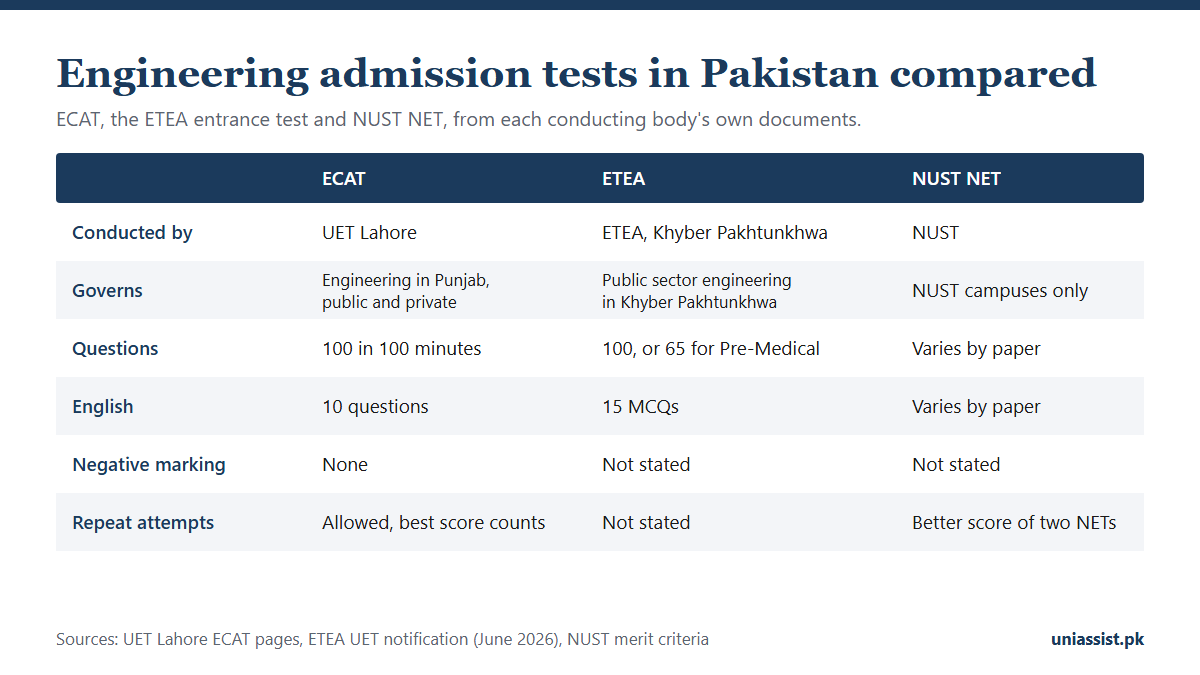
| ECAT | ETEA | NET | |
|---|---|---|---|
| Questions | 100 | 100, or 65 for Pre-Medical | Varies by paper |
| English included | 10 questions | 15 MCQs | Varies by paper |
| Negative marking | None | Not stated in the composition notification | Not stated in the merit criteria |
| Repeat attempts | Permitted, best score counts | Not stated in the composition notification | Best score where both relevant NETs are sat |
What to do with this
Three things are worth settling before you register for any of the engineering admission tests in Pakistan:
- Build your shortlist first, then work out the tests. The test follows the university, not the other way round. A shortlist spanning Punjab, KP and NUST may need three separate registrations.
- Check the institution and the programme, not just the province. UET Taxila accepting both ECAT and TCAT, and UET Lahore exempting some of its own programmes from ECAT, are both reasons provincial shorthand is not reliable.
- Confirm composition and weightage with the conducting body each cycle. Paper structures and merit formulas are set by the university or agency running the test and are revised between intakes.
If you are still deciding between fields rather than institutions, our broader guide to which entry test governs which route covers medicine, law and postgraduate admission alongside engineering.
Common questions
Can one test cover every engineering university I apply to?
Not reliably. Engineering admission tests in Pakistan are set by province and by institution. ECAT covers undergraduate engineering admission in Punjab at both public and private institutions, but NUST admits on its own NET, Khyber Pakhtunkhwa runs through ETEA, and UET Taxila operates its own TCAT alongside ECAT.
Can a Pre-Medical student apply for engineering?
Through ETEA, yes: Pre-Medical with Additional Mathematics is listed under the Pre-Engineering test group. For ECAT, combination (iv) is Biology, Physics and Chemistry. Whether a given programme admits on that background is set by the institution.
Do DAE and B.Tech holders qualify?
For the ETEA entrance test, both are named in the Pre-Engineering group’s eligibility. For ECAT, DAE candidates choose between two fixed subject sets. Whether a degree programme then accepts that route is a separate question for the university.
How much does the entry test actually count?
It varies by institution and is the single most important number to check. At NUST the NET carries 75% of merit. A formula that leans heavily on the test rewards very different preparation from one that leans on your HSSC result.
Sources
- UET Lahore, About ECAT and Programs: ecat.uet.edu.pk
- Educational Testing and Evaluation Agency, Composition, Weightage and Schedule of Entrance Tests (UET, June 2026): course content notification
- UET Taxila admissions portal, ECAT-2026 and TCAT-2026 registration notices: admissions.uettaxila.edu.pk
- NUST, Merit Generation Criteria for UG admission on NET basis: nust.edu.pk